COOLINGCONTAINER.ME REV P2
REV P2 — ENGINEERING PACKAGEESTIMATE FLAGS PENDING VENDOR SELECTION

40 ft High-Cube GPU/HPC Liquid-Cooling Container

Full-liquid W45 direct-to-chip (fanless) · two-loop · 3× ground-skid dry coolers — OFF-GRID 3× 750 kW NG gensets (N+1) · 1 MW / 2 MWh BESS · 800VDC-ready · Permian Basin, TX.

432 GPUs (6× NVL72) · ~124 TB HBM — a frontier open-weight AI factory in one box.

100% liquidoff-grid NGBESS on-skid
Site — Permian Basin, TX0 grid kW — pipeline gas101 °F DB / 67 °F MCWB · ASHRAE 0.4%~2,861 ft altitudeERCOT
01Why now — the open-weight moment

Frontier AI just became
a product you can own

On July 27, 2026, Moonshot AI released the weights of Kimi K3 — a 2.8-trillion-parameter mixture-of-experts model, the largest open-weight release ever, benchmarked at the level of the most advanced American models (top-3 across the major intelligence indices).

And it did not stop: DeepSeek V4-Pro (MIT), GLM-5.3-Flash (MIT, 1M context), Qwen3.8-Max, Hunyuan Hy4 — downloadable frontier-class weights now land every week. A frontier model is no longer an API subscription. It is a file you download — and it serves from a single rack-scale footprint: a ~$0.5M-class hardware entry point (ESTIMATE), not a hyperscale build.

That changes who buys infrastructure. Every company can now run its own AI — weights on its own metal, inside its own perimeter. It doesn't watch you. It doesn't train on your data. It doesn't leak to competitors. And it answers to no one else's roadmap, rate limit, or deprecation notice.

But owning the model means owning the physics: 135–155 kW of heat per rack that never touches air, and a megawatt of power the grid interconnect queue won't deliver for years. That load doesn't go in a server closet — it goes in a purpose-built module. The 40 ft self-contained liquid-cooling container is the deployment unit of the open-weight era: set it on a pad, feed it pipeline gas, and a private frontier AI is on-prem — no interconnect queue, no stick-built construction.

Sources — Moonshot AI release materials · VentureBeat, 2026-07-16 · Artificial Analysis & Vals AI indices · model cards as of Aug 2026 · hardware entry point = ESTIMATE, pending config

Weights releasedKimi K32026-07-27 · Moonshot AI · open-weight
Scale2.8T params MoElargest open-weight model ever released
LevelTop-3 frontierparity with US flagship models on major indices
Entry point~$0.5M classESTIMATE · rack-scale hardware, not hyperscale
Data gravity0 leaves the buildingno telemetry · no retention · no leakage
Deployment unit1 module = 6 racksfactory-built · ~90-day target · drop on a pad
02Purpose — what ~1 MW buys

One box. Every
frontier open-weight model

  • Any current open-weight model in one replica — up to the 2.8T-MoE class. One NVL72 rack ≈ 21 TB HBM; the box pools ~124 TB.
  • Or 50–100+ concurrent replicas of the 13–18B-active serving tier — this is where 1 MW pays off.
  • 2–3 racks as a training partition: fine-tune / continued-pretrain 70B–400B dense or mid-size MoE.
  • 1M-token contexts with 10–15% of HBM held as KV headroom — the real limiter is KV cache, not weights. FP8 production, NVFP4 native on Blackwell.
  • Serving stack that works at this scale: vLLM · SGLang · TensorRT-LLM · DeepEP expert parallelism — NVLink/NVSwitch in-rack, 400/800G RoCE or IB between racks.

Power is the bottleneck, not silicon: interconnect queues plus stick-built construction run to years. This module is factory-built to a ~90-day target and sited at the fuel — pipeline gas in, frontier tokens out.

Compute432 GPUs6× GB300 NVL72 · Blackwell Ultra
Memory pool~124 TB HBM~21 TB per rack
Module load810 kW IT~0.97 MW with cooling parasitics
Grid draw0 kWoff-grid on pipeline gas · BESS on skid
The open-weight fleet for this box — model landscape Aug 2026, not independently verified
ModelSize (total / active)ContextLicenseRole on this box
Kimi K32.8T / ~104B1Mcustom K3open-weight intelligence ceiling — one prestige replica, not twenty
DeepSeek V4-Pro1.6T / 49B1MMITmost permissive giant — workhorse for private fine-tunes
Qwen3.8-Max2.4T / 95B262K–1Mcustomboard-topping generalist — text weights public
Hunyuan Hy4 (preview)770B / 49B1Mopen — confirm SPDXfresh coding/research/finance — pin a canary replica
GLM-5.2 / 5.3~750B / 40B1MMITagent/coding family workhorse
GLM-5.3-Flash320B / 18B1MMITdefault public endpoint — ~300 GB FP8, 50–100+ replicas per MW
DeepSeek V4-Flash284B / 13B1MMIThighest tokens/watt in the frontier set
Qwen3.8-27B27B dense262KApache 2.0routers, RAG, vision — fits 1–2 GPUs
gpt-oss-120b117B / 5.1BApache 2.0Western reasoning tier, easy compliance story

A sane split on one module: 1–2 racks single-replica flagship (K3 / Qwen3.8-Max class) · 2–3 racks training + LoRA partition (V4-Pro, GLM-5.x, Hy4) · remaining power Flash autoscaled for API · a few nodes for 27B-class routers, embeds, classifiers · hold 10–15% headroom for KV.

License reality check: MIT / Apache tiers are safest to sell on. K3, Qwen3.8-Max, Llama 4 are open weights with commercial clauses — read the card before you put them behind a paid API.

03What this is

A containerized GPU/HPC
cooling module

Rev P2 engineering package for a containerized GPU data-center module. Full-liquid W45 direct-to-chip cooling — 100% liquid, fanless, no RDHx — is the default basis.

  • Two loops isolated by a CDU plate heat exchanger (5 °C approach); 3× ground-skid adiabatic dry coolers reject ~850 kW.
  • OFF-GRID power: 3× 750 kW NG gensets (N+1: 2 duty + 1 standby) + load-bearing 1 MW / 2 MWh BESS sited at 3.0 m; 800VDC-ready. Grid stays a dashed FUTURE block — provisioned, not built.
  • Safety & controls: rope leak detection · auto-isolation <60 s · dry-break quick disconnects · 2N VFD pumps.
  • Climate basis: 101 °F DB / 67 °F MCWB (ASHRAE 0.4%), ~2,861 ft altitude, ERCOT.
Envelope40 ft High-Cube ISO12030 × 2350 × 2640 mm interior
IT load~810 kW6× GB300 NVL72 racks @ 900 mm pitch
Rejection~850 kW3× adiabatic dry coolers
Storage1 MW / 2 MWhLFP skid @ 3.0 m · NFPA 855 · load-bearing
Power plant3× 750 kW NGN+1 · 2 duty + 1 standby · pipeline gas
Site pad~460 m²27.2 × 17.0 m incl. cooler skid, gen row (7.6 m sep.), BESS
04Specification

Locked design basis

Rev P2 · estimate flags pending vendor selection
GPU platformNVIDIA GB300 NVL72Blackwell Ultra · MGX 48U
Rack750 × 1200 × 2294 mm~1590 kg wet · floor rated 2000 kg/position
Rack power135 kW nom / 155 kW peakbusway to 192 kW
Quantity6 racks → ~810 kW ITsingle row, 900 mm pitch
Default modefull_liquid100% liquid · fanless · no RDHx (hybrid = legacy variant)
TCS loop40 / 52–55 °C197 LPM/rack · 1182 LPM total (312 gpm) · DN125 header standard
FWS loop45 / 57 °C25% PG glycol · ~360 gpm
CDU — selectedCoolIT CHx1000 ×2N+1 · plate-HX isolation, 5 °C approach · 2nd source Vertiv XDU1350
Dry coolers3× ground-skid adiabaticESTIMATE · N+1 in-module, N+2 at fleet
Heat balance~850 kWIT 810 + pumps ~12 + envelope ~6 + elec ~22 (ESTIMATE)
BESS1 MW / 2 MWh LFPload-bearing off-grid @ 3.0 m (NFPA 855) · ride-through ~141 min
Power sourceOFF-GRID 3× 750 kW NGN+1 (2 duty + 1 standby) · Generac MG750 · 2nd src Cat G3516 class (lead = ESTIMATE)
AI payload432 GPUs · ~124 TB HBMany open-weight model in one replica · 50–100+ Flash-tier replicas
PerformancePUE ~1.20design-day · annualized 1.15–1.25 · WUE 0.02–0.09 L/kWh
05Process

Two-loop W45
architecture

TCS — technology loop

DI / 25% PG to the rack cold plates — 40 °C supply, 52–55 °C return. 1182 LPM on a DN125 header.

FWS — facility loop

25% PG glycol — 45 °C supply, 57 °C return to the dry coolers.

  • CDU plate heat exchanger isolates the loops: clean rack-side fluid inside, glycol outdoors.
  • 100% of board heat on liquid (default) — no residual-air RDHx branch, no fans.
  • 3× dry coolers reject ~850 kW; adiabatic trim only 100–300 hr/yr on RO water.
P&ID-101Two-loop W45 DTC liquid coolingRev P2
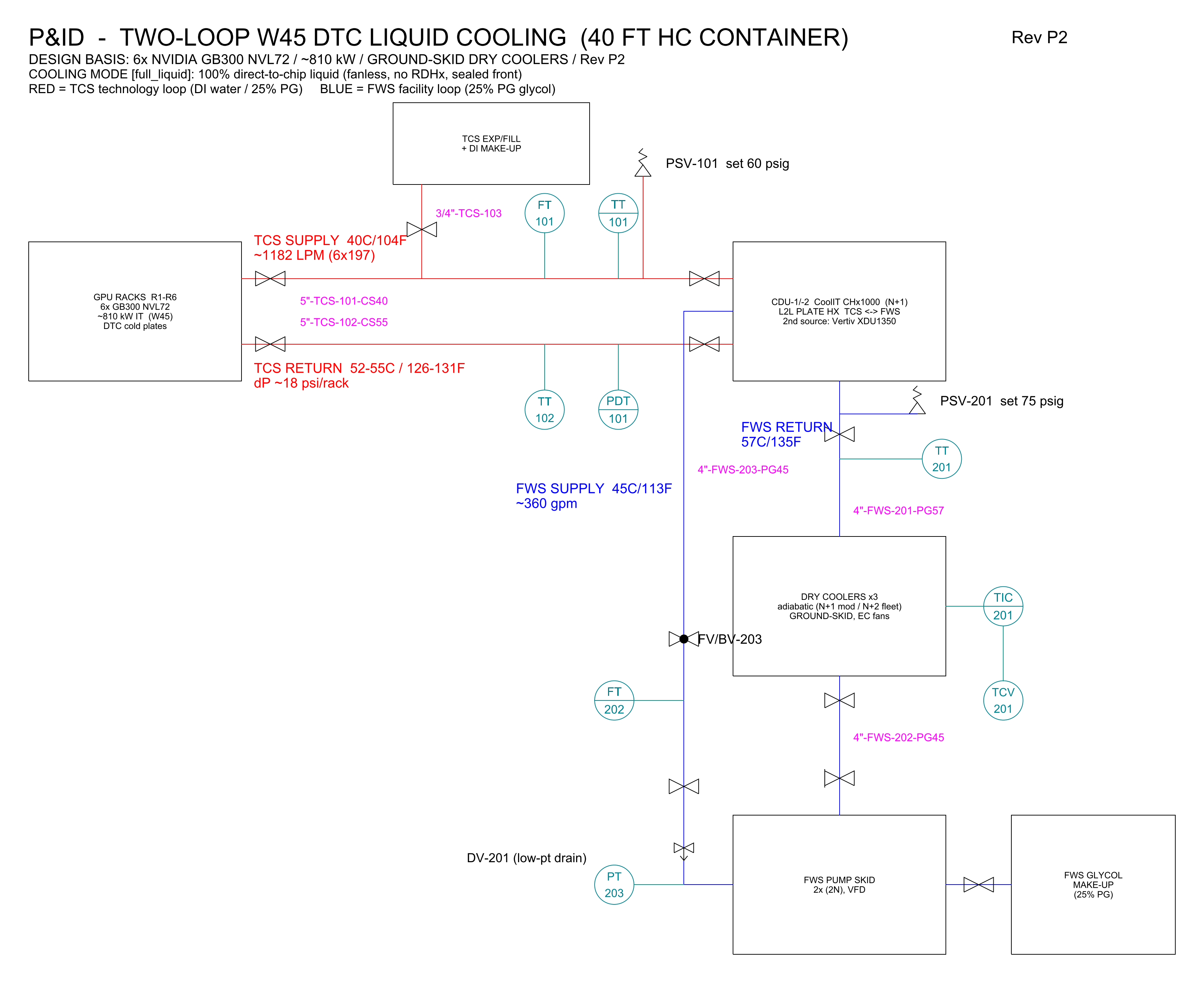
P&ID of the two-loop W45 direct-to-chip liquid cooling system showing TCS and FWS loops, CDU, dry coolers and pump skid
ISA P&ID. Red = TCS technology loop (DI water / 25% PG) · Blue = FWS facility loop (25% PG glycol). PSV-101 set 60 psig, PSV-201 set 75 psig; 2N VFD pump skid with glycol make-up.
06Layout basis

The ground-skid
change

WasRoof-mounted coolers600 mm rack
Now — Rev P2Ground-skid on adjacent pad750 mm rack · FWS through the rear side wall

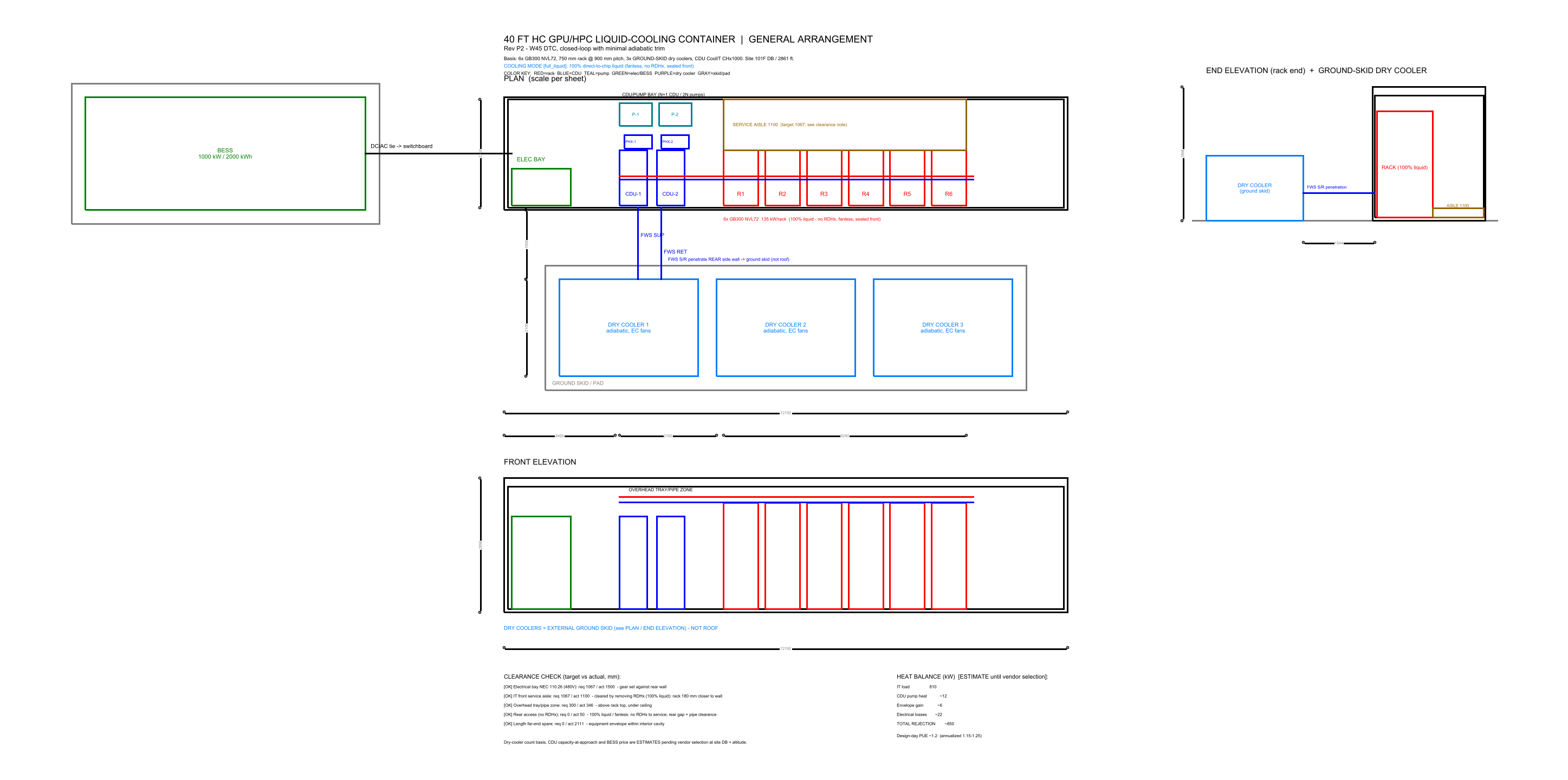
The 40 ft High-Cube envelope is retained for the overhead tray/pipe zone. The end elevation shows the skid on grade beside the container with the FWS penetration.

A-101General arrangement — plan / front / endRev P2
General arrangement drawing: plan, front elevation and end elevation of the 40 ft container with rack row, CDU bay, electrical bay, BESS and three ground-skid dry coolers
GA, dimensioned and layered (DXF R2018). Interior: 6-rack row, CDU/pump bay, electrical bay, overhead header run. Outdoor: 3-cooler ground skid + rear-wall FWS penetrations, NG gen row + gas skid, BESS at 3.0 m. On-sheet heat-balance table (810 + 12 + 6 + 22 = ~850 kW) and all-OK clearance note. Redundancy labelled: gensets N+1 (2 duty + 1 standby), coolers N+1 in-module / N+2 fleet-pooled.
07Method — single source of truth

One parameter file,
zero drift

Every dimension and process value lives in one Documentation file. The 3D model, 2D drawings, ISA P&ID and IFC all import it — nothing is hard-coded twice.

A Layout object computes all positions once, so model and drawings cannot drift. Zone boundaries, aisles and pad extents are computed in params, never drawn by hand. Change a value → re-run → the whole package updates consistently.

Consistency is structural, not manual: an impossible combination (e.g. BESS off + off-grid NG) is a hard error at generation time, not a shipped drawing.

Documentationparams.pyevery dimension & process value, one place
→ 3D modelSTEP · STL · GLBvalid B-rep parametric assembly
→ DrawingsGA · P&ID · SLDDXF R2018, dimensioned + layered
→ BIMIFC4classified entities for coordination
→ Sheet setPNG · PDFpreviews, text dumps, combined PDF
14–15The problem · the comparison

The engineering problem nobody had solved

Earlier “liquid-cooled” servers were hybrid: cold plates on GPU/CPU only. Memory, NICs, NVSwitch, PSUs and VRMs still rejected heat to air → fans, perforated bezels, RDHx.

The unsolved problem: cool 100% of the board on liquid. NVIDIA’s Rubin answer: liquid to every chip via a single tray inlet/outlet → sealed front, no fans, 6U→2U.

2026 convergence: the industry is trending 100% cold-plate fanless at 300 kW/rack, with the 100%-cold-plate class forecast at >10M units by 2027 — cold-plate beats immersion ≈ 95:5. Our baseline is exactly the architecture NVIDIA’s “Liquid Cooling AI Factories” describes as the previous, unsolved state.

Our original GB300 basis (~90% liquid + ~10% air → 6× RDHx) was that hybrid approach — at Rev P2 the 100%-liquid answer is the default.

Metrichybrid (legacy)full_liquid — P2 default
Architecture~90% liquid + air100% liquid, fanless
RDHx / fans6 / required0 / none
Liquid load729 kW810 kW
TCS flow · header1062 LPM · DN125 (std)1182 LPM · DN125
Total rejection~850 kW (heat balance)~850 kW (heat balance)
Front service aisle920 mm — FLAG1100 mm — OK

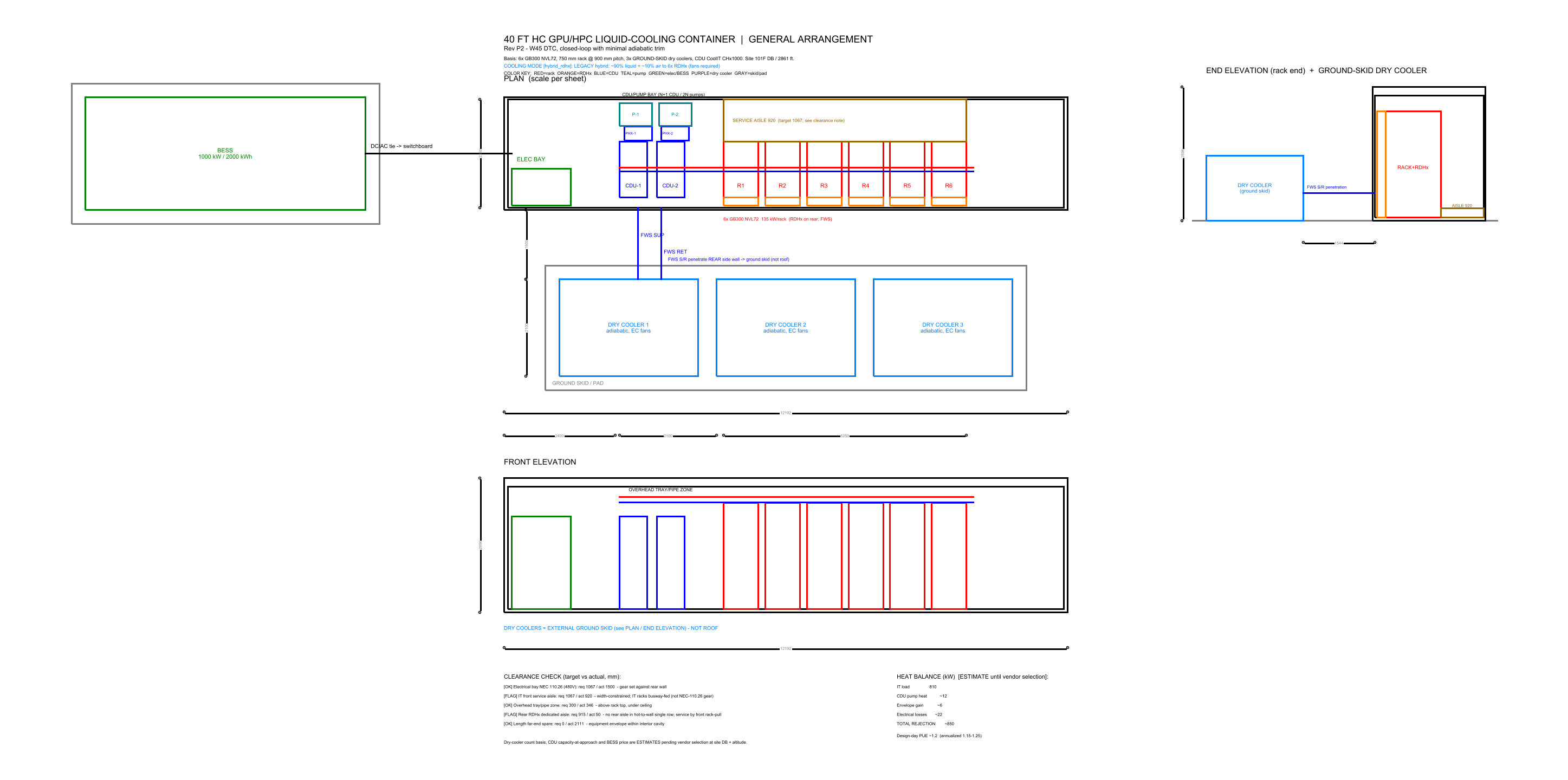
Removing the 180 mm RDHx opens the aisle 920 → 1100 mm — every clearance clears.

A-102Legacy hybrid GA — RDHx row, 920 mm aisle flagsuperseded
Legacy hybrid general arrangement showing the RDHx row and the flagged 920 mm service aisle
Legacy variant, kept for reference. The hybrid build retains its historical 920 mm / rear-aisle flags — one driver for the P2 default flip.
16Why it matters

Efficiency, water, noise

~2M gal/yrwater avoidedvs water-cooled (0.81 MW) — evaporative baseline ~2.6 M gal/MW/yr → near zero with warm-water closed loop + dry coolers
85+ dB → 0fan noise eliminatedfanless build — no server fans, no RDHx fans
1.15–1.25annualized PUE banddesign-day ~1.20 (ESTIMATE) — fan + chiller parasitics removed

Energy. ~4% cooling-cost cut per +1 °C loop temperature; >$4M/yr at 50 MW → order ~$65k/yr here (climate-dependent).

Waste heat. The 40–57 °C FWS loop is offtake-grade for district / greenhouse heat reuse (site-dependent).

Claim language. “Closed-loop with minimal adiabatic trim” — never “water-free.”

17Energy storage

On-skid BESS —
load-bearing, not backup

Part of the Rev P2 basis: a 1 MW / 2 MWh LFP skid off the electrical end, sited at 3.0 m from the compute container per NFPA 855 (2026). Shown in the 3D model, GA, IFC and isometric; storage node + ride-through note on the single-line.

  • Gaseous engines accept only ~25–50% block load steps, while a GPU cluster swings ~280–465 kW in seconds — the BESS bridges the step.
  • One derated genset (638–675 kW) cannot carry the 1092 kW peak during an N−1 event — the battery covers the gap until load shed. Bare N+1 would not be honest.
  • Fanless full-liquid has no air fallback, so thermal ride-through IS the battery: ~141 min at full 850 kW, ~741 min cooling-only.
  • BESS-off + off-grid NG is a forbidden combination — the parameter file raises a hard error rather than shipping it. 4CP peak-shave / ancillary revenue applies only in the grid legacy variant or once the FUTURE interconnect is built.

Chemistry, cell selection and price remain ESTIMATE pending vendor quote.

1000 kWdischarge~full module load
2 MWhLFP capacityestimate
~141 minride-through@ 850 kW (~741 min cooling-only)
11Deliverable · electrical — off-grid

Electrical
single-line

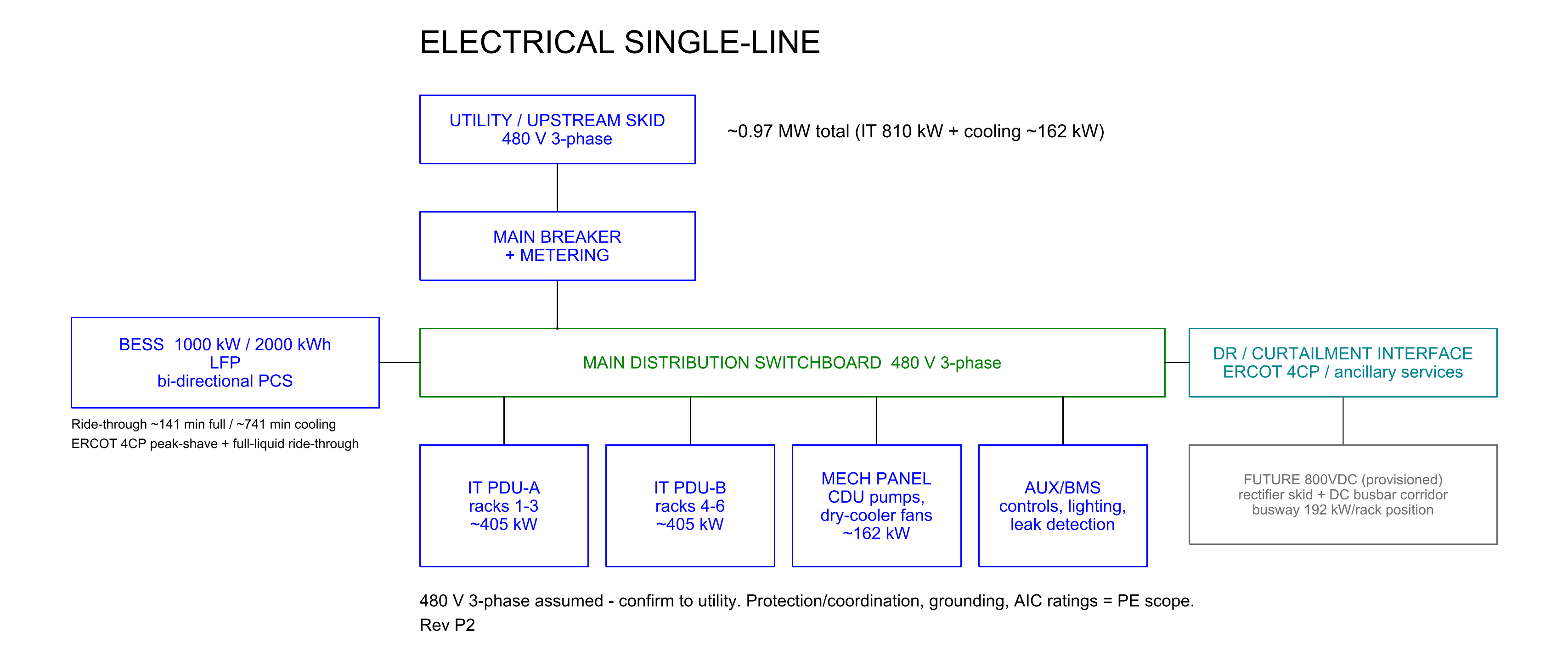
  • OFF-GRID source: NG gen plant 3× 750 kW, N+1 = 2 duty + 1 standby (Generac MG750 + paralleling switchgear) → main breaker → 480 V switchboard.
  • Peak 1092 kW on N=2: derated capacity 1275–1350 kW → margin 183–258 kW, 81–86% loading (derate ESTIMATE).
  • BESS is load-bearing off-grid: GPU step bridging + N−1 genset contingency.
  • Branches: IT PDU-A / PDU-B ~405 kW each, mech panel (pumps, cooler fans) ~162 kW, aux / BMS. Design-day ~0.97 MW total.
  • Dashed FUTURE blocks: grid interconnect (DR / ERCOT 4CP active only then) and 800VDC rectifier skid + DC busbar corridor — both provisioned today.
E-101Electrical single-line — off-grid NG plant, 480 V busRev P2
Off-grid electrical single-line diagram: 3x 750 kW NG genset plant to main breaker, 480 V distribution switchboard, PDU branches, load-bearing BESS, future grid interconnect and 800VDC blocks
480 V 3-phase generation bus (off-grid NG plant). Protection/coordination, grounding, AIC ratings = PE scope. Pipeline NG + regulator skid. Busway 192 kW/rack position provisioned.
08–10 · 12Outputs · deliverables

What ships in the package

3D modelSTEP · STL · GLBvalid B-rep — fabricator / CAD-importable
2D drawings (DXF)GA · single-line · P&IDISA P&ID + block P&ID
BIMIFC4classified entities for coordination
Sheet setPNG · text · PDFpreviews · dumps · combined PDF
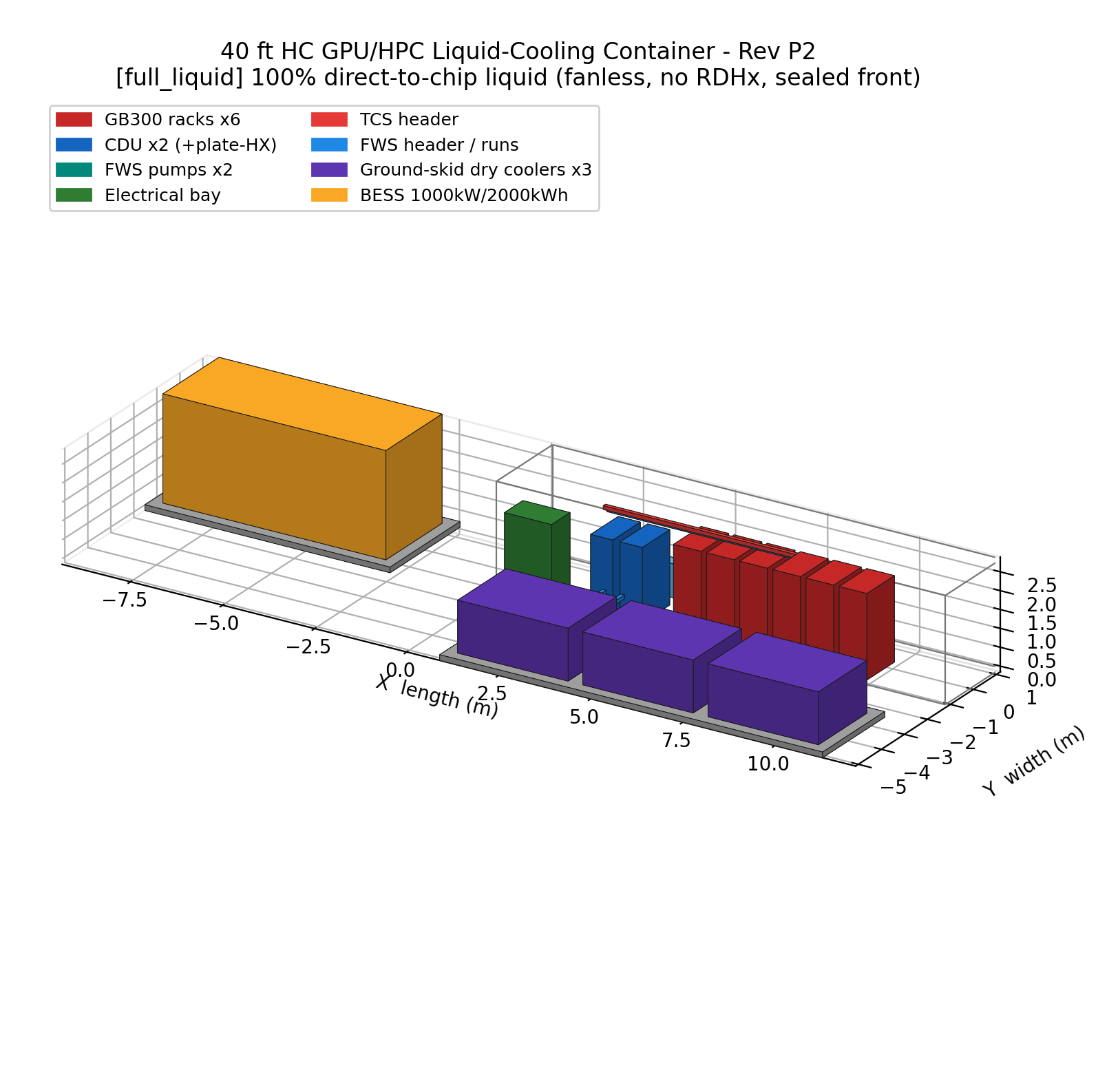
M-1013D model — build123d parametric assemblyRev P2
3D block layout of the container module: six GB300 racks, two CDUs, pumps, three ground-skid dry coolers and the BESS skid
Parametric assembly: shell, 6 racks, 2 CDUs + plate-HX, 2N pumps, two-loop headers + drops, electrical bay, 3 ground-skid coolers, NG gen row + gas skid, BESS skid at 3.0 m. bbox X[−9358, 17796] · Y[−15457, 1519] · Z[−150, 2900] mm (incl. gen row + BESS).
38/38valid B-rep solidsSTEP export, zero failures
IFC4coordination model37 classified products (incl. 3× NG gensets + BESS + spatial structure)
IFC classification — schema validation: 0 issues
EntityIFC class
IT racksIfcBuildingElementProxy
Plate-HX (CDU integral)IfcHeatExchanger
CDUsIfcUnitaryEquipment
FWS pumpsIfcPump
Dry coolersIfcCoolingTower
TCS / FWS headersIfcPipeSegment
Electrical gearIfcElectricDistributionBoard
NG gensets (×3)IfcElectricGenerator
BESSIfcElectricFlowStorageDevice

Container interior = IfcSpace; floor/roof/walls = IfcSlab / IfcWall. Pset_ConceptBasis carries the Rev P2 basis: CDU CoolIT CHx1000, heat balance, future-proofing. Every shaped entity meshes with valid geometry.

13Engineering check

Clearance check —
every P2 check passes

The full-liquid default removes the 180 mm RDHx → front aisle 920 → 1100 mm. The legacy hybrid variant (./out_hybrid) retains its historical 920 mm / rear-aisle flags — one driver for the P2 default flip.

CheckTarget (mm)Actual (mm)Result
Electrical bay NEC 110.26 (480 V)10671500OK
IT front service aisle10671100OK
Overhead tray/pipe zone300346OK
Rear access (no RDHx)050OK
Length far-end spare≥02111OK
NG exhaust → dry-cooler intake (ESTIMATE → CFD-screened)76007600OK
CFDEngineering check — exhaust recirculation, computed

Hot exhaust,
tracked in the wind

The 7,600 mm exhaust→intake separation was a 25 ft rule-of-thumb. It is now screened by CFD: a steady RANS model (OpenFOAM 2512, simpleFoam, k–ε) of the whole pad — container, BESS, three coolers, three gensets — with a passive exhaust tracer released at each roof louvre.

  • 58,658 all-hex cells; checkMesh clean (0 non-orthogonality, 0 skew).
  • Tracer s = 1 at each 1.2 × 1.2 m exhaust louvre (~4.3 m/s, 450 °C ESTIMATE — genset datasheet unverified); s = 0 ambient. Design-day 38.3 °C.
  • Two cases: adverse wind 3 m/s blowing the plume at the coolers, and calm 0.3 m/s.
  • Buoyancy deliberately not modelled — plume rise is suppressed, so the intake numbers are a conservative bound.
  • Residuals plateau at 1e-4…4e-3 — screening quality, not certification. Vendor selection software confirms at rating conditions.
≤ 4 °Cmax intake rise — adverse windworst point on any cooler intake face, 3 m/s toward the row
1.3 °Cmean intake rise — adverse windface-averaged over the three intakes
≤ 1.5 °Cmax intake rise — calm0.3 m/s · mean 0.7 °C
HOLDS7,600 mm separationwith margin — confirm at vendor rating with +4 °C intake allowance
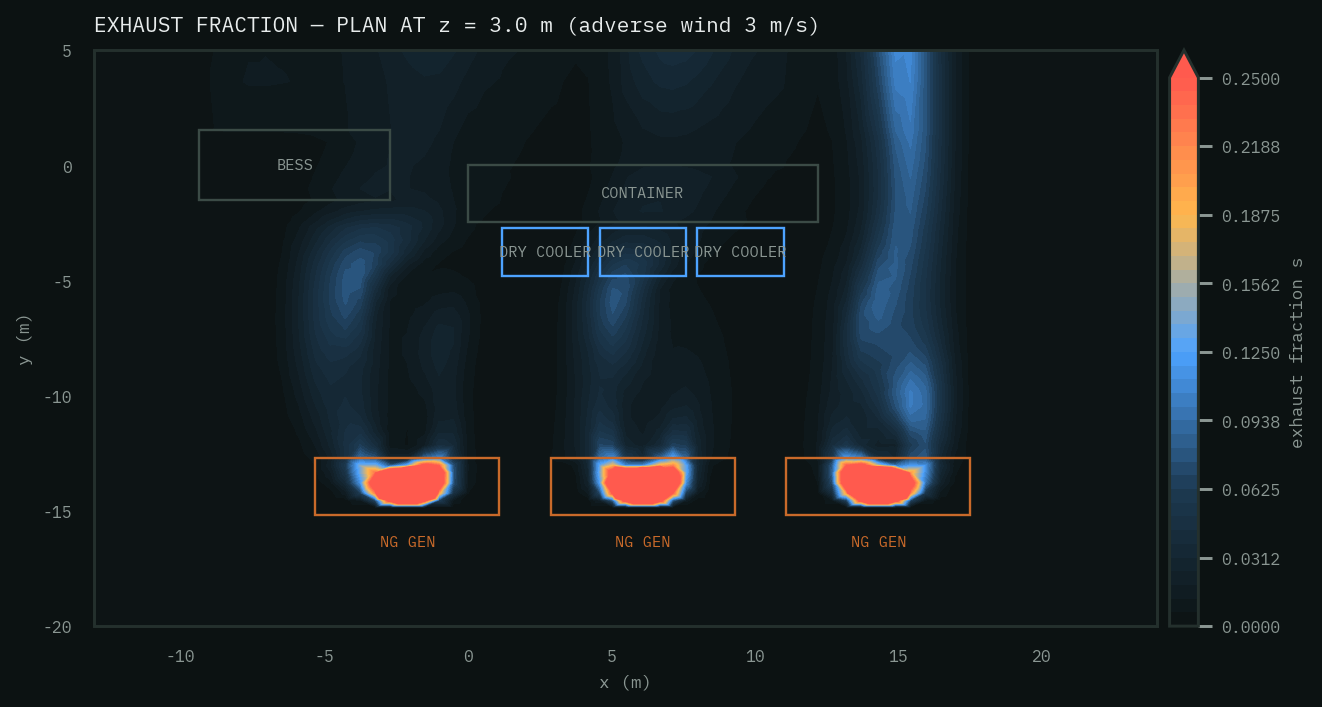
CFD-101Exhaust fraction — plan at z = 3.0 mRev P2
Plan-view contour of exhaust fraction at exhaust height showing the three genset plumes drifting toward the dry cooler row and diluting
Adverse wind 3 m/s. The three plumes bend toward the cooler row and dilute to ≤1% of exhaust concentration before the intake plane.
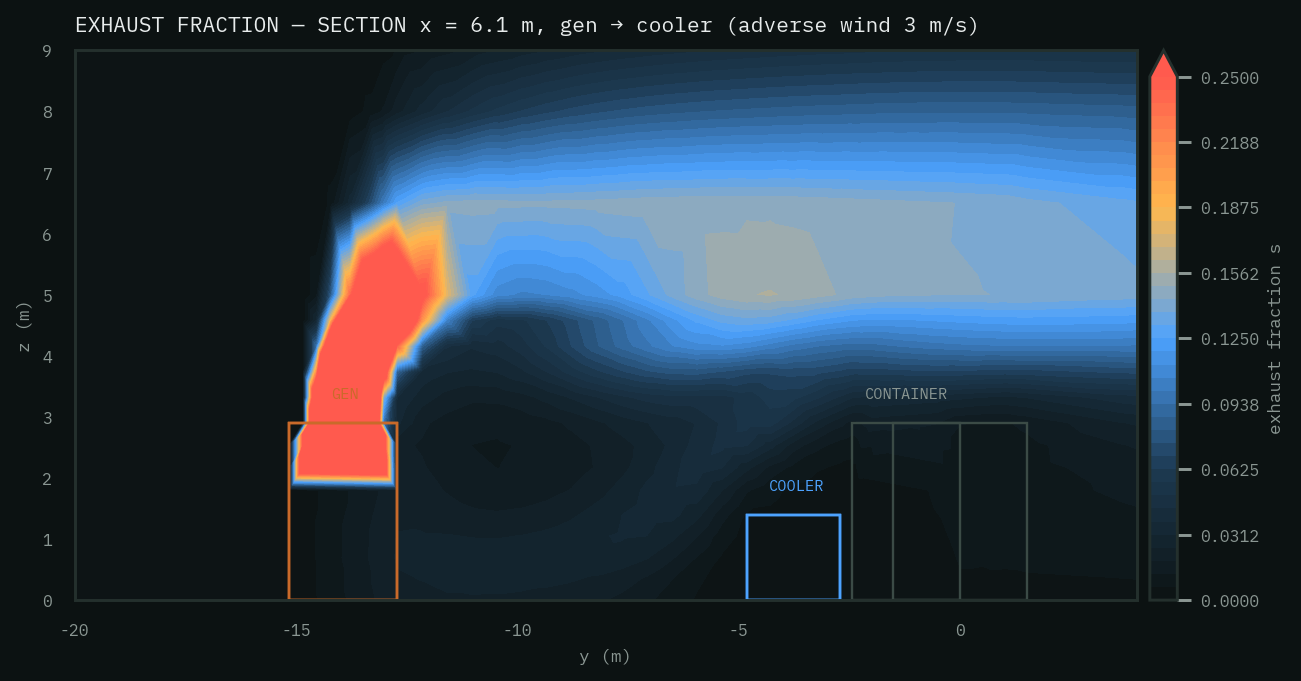
CFD-102Section through GEN-2 → cooler 2Rev P2
Vertical section contour of exhaust fraction showing the plume jetting from the genset roof and staying mostly above intake height
Momentum carries the plume up and over. Only the diluted tail grazes intake height (z ≤ 1.4 m). Buoyancy — not modelled — lifts it further.
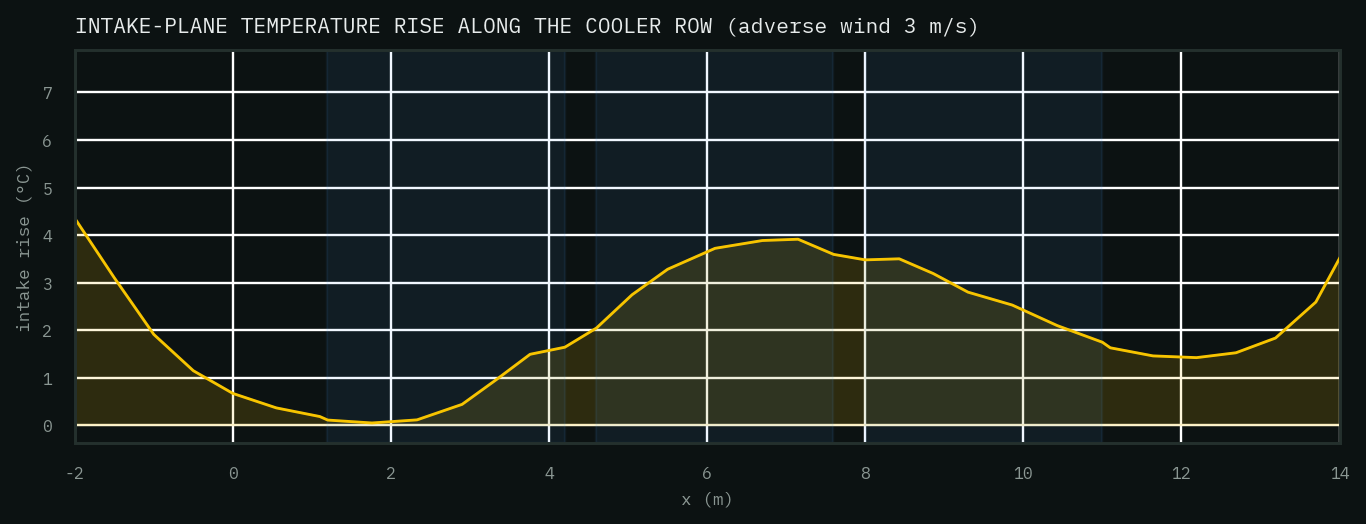
CFD-103Intake-plane temperature rise along the cooler rowRev P2
Profile of intake temperature rise along the cooler row under adverse wind, peaking near 4 °C on the middle cooler
Shaded bands = the three cooler intakes. On-cooler maximum ≈ 3.9 °C, row mean ≈ 1.3 °C. Calm case: max ≈ 1.5 °C. Intake rise = tracer fraction × (450 − 38.3) °C.

Case + figures regenerate from cfd/gen_case.py → OpenFOAM (docker) → cfd/make_figures.py · exhaust louvre size, flow and temperature = ESTIMATE pending genset datasheet

18Scaling

Fleet crossover:
shared pod wins at N ≥ 5

The self-contained 40 ft module is the product — scale a site by replicating it.

  • Crossover (P2 basis): a shared utility pod wins at N ≥ 5 modules within a ~150 m piping radius — pooling recovers ~15–20% of MEP CAPEX (ESTIMATE).
  • Beyond ~150 m the pooling savings die in installed pipe, pumping head (PUE creep) and glycol inventory.
  • It flips back to self-contained where independent failure domains are worth more than the pooling saving.
  • 2-storey stacking is a further density lever (structural / seismic — future).
~150 m piping radius Shared utility pod CDU · pumps switchgear · BESS ground-skid dry coolers — N+2 at fleet Compute pod 6× GB300 Compute pod 6× GB300 Compute pod 6× GB300 Dry cooler Dry cooler Dry cooler FWS pooling · shared BESS · independent failure domains per compute pod
19Adopted · go-to-market

Productization & deployment

Deployment / commercial posture (Duos-validated) — concept-stage, flagged for the next phase; not engineered here.
Repeatable building blockFactory-builtL11-class integration ≥90% + water/power blind-mate · ~90-day target · CAPEX or OPEX
Physical securityControlled entryman-trap vestibule · 24×7 monitoring · leak detection · SOC 2
Power accessOFF-GRID NG plantdefault — sited at the fuel · 4CP / DR only where grid-connected
Certified domestic unitMade-in-USAmanufacturer-agnostic · UL/CSA whole-unit factory-certification path (open item)
20Honesty — risks & caveats

Do not
understate

The open ESTIMATE flags: dry-cooler count basis (3/module), CDU capacity-at-approach, BESS price, PUE band, NG-genset lead time / site derate / prime-duty certification.

ESTIMATE FLAGS PENDING VENDOR SELECTION
  • No airNo air fallback in the full-liquid default: loss of coolant is an immediate thermal event → leans on 2N pumps, sub-60 s ≤0.5 ml-class leak detection + drip-tray/drain containment (benchmark-adopted, ESTIMATE), auto-isolation, ~141 min BESS ride-through and a defined trip.
  • Hydraul.Higher TCS flow & head (1182 LPM, DN125): rack ΔP and pump head to re-confirm — hydraulic model out of scope.
  • Rubin>190 kW/rack is a separate capacity axis (busway to 192 kW, floor 2000 kg/rack already in basis), not a coolant-temperature risk.
  • BESSSeparation locked at 3.0 m (NFPA 855, 2026); PCS protection remains PE scope; price = ESTIMATE.
  • CFDExhaust → intake separation CFD-screened (steady RANS, passive tracer, no buoyancy → conservative): ≤ ~4 °C intake-rise bound on the adverse-wind design day; vendor to confirm at rating conditions. Exhaust louvre size / flow / temperature = ESTIMATE pending MG750 datasheet.
  • StampsNo PE stamp, no protection coordination, no fire/life-safety design.
21Summary & next steps

Unified basis. All-green checks.

  • Rev P2 unified basis: 100%-liquid fanless default, OFF-GRID 3× 750 kW NG plant (N+1), 3 dry coolers, CoolIT CHx1000 selected, load-bearing BESS on-skid at 3.0 m, 800VDC-ready — one parameter-driven source of truth.
  • Closed heat balance (~850 kW) and an all-green clearance check in the default build.
  • Fleet path documented: self-contained module is the product; shared utility pod wins at N ≥ 5 within ~150 m.
  • Open-weight frontier models (Kimi K3 weights released 2026-07-27) turn private AI into a rack-scale purchase — the module is the deployment unit.
Next
  • 01Vendor selection run — dry coolers + CDU at 101 °F + altitude.
  • 02Hydraulic / thermal model · Fusion refinement · PE detailed design.
Request Rev P2 package STEP · DXF · IFC4 · sheet set — released under NDA at vendor-selection stage.
TCS sup40.0°C
TCS rtn53.4°C
Flow1182LPM
FWS sup/ rtn45.0 / 57.0°C
Rejection~850kW
PUE1.20design-day
BESS141min ride-through
NG gen2×750kW duty · N+1
Request Rev P2 package